What Nobody Taught Us Trilogy · Book 3
Worth Following
The Science of the People Others Choose to Follow
Not the person with the most power. The person most worth following.
On Amazon November 24, 2026

- 30principles in five parts, each with its seal
- 10myths about success the science takes apart
- 90days of planning, with a workbook
- 25years of practice behind every page
If getting better feels comfortable, you’re probably not getting better: you’re just going over what you already know.
Sergio Pérez Serer · Worth Following
This book is for you if you’ve ever wondered
“Why does what comes so naturally to others cost me so much?”
What it’s about
We don’t follow the biggest title
We don’t follow the loudest voice, the biggest title or the boldest show. We follow the people who bring direction, calm, trust and consistency.
In Worth Following, Sergio Pérez Serer distils what science and more than twenty-five years of clinical practice reveal about the people others choose to follow: why they inspire trust, how they govern their emotions under pressure, how they influence without imposing, and what legacy they leave in those who work beside them.
Thirty principles, each with its own scientific evidence rating, real cases from the consulting room and a practice to start this very week. Includes an opening self-assessment, a 90-day plan, a workbook and free access to the companion app.
A book for those who want to become someone others follow, not out of obligation, but out of conviction.
You’ll discover
- 01
Why talent decides where you start, but not how far you go.
- 02
How to govern your emotions under pressure, and why calm is contagious.
- 03
How to influence without imposing: prestige over power, warmth before competence.
- 04
What makes a team dare to tell the truth, and how to build that safety.
- 05
How to decide with a cool head, persevere wisely and avoid the shortcut that always costs more.
- 06
Which myths about success and leadership don’t survive the science, and what replaces them.
A journey from the inside out
Thirty principles, each with its seal
They start on the inside, because nobody follows someone who can’t govern themselves, and they end with what you leave in others. Every chapter: a real scene, the principle in one sentence, what the studies say, what the author has seen in practice, the most common mistake, and a practice for this week.
Strong evidenceStrong evidence
Many studies, with thousands of people, replicated by other researchers.
Promising evidencePromising evidence
Good studies pointing the same way, not yet enough to treat it as settled.
MythMyth
Repeated everywhere, but the science doesn’t support it or has refuted it.
Part OneThe leader withinSelf-knowledge, confidence, values and identity. Leading yourself before anyone else.
- 1
Talent is overrated Promising evidence
Talent decides where you start. What you do with what you learn decides how far you go.
- 2
Believing you can changes what you can Strong evidence
You don’t do what you know how to do. You do what you believe you are capable of doing.
- 3
The mirror almost nobody uses Promising evidence
Leading well requires seeing yourself as others see you, and almost nobody manages it without help.
- 4
The impostor who lives inside high achievers Promising evidence
Feeling like an impostor doesn’t mean you are one. It means you haven’t yet believed your own evidence.
- 5
Values: the compass that decides when you can’t Promising evidence
The people others follow don’t have more values than anyone else. Theirs are clearer, and they keep them when it costs.
- 6
Becoming someone worth following Strong evidence
People don’t follow the person above them. They follow the person who best represents what the group wants to be.
Part TwoEmotional masteryPressure, fear, mistakes and resilience. What happens inside you when everything gets complicated.
- 7
Emotions are data, not orders Promising evidence
What you feel is information about what matters to you. Always listen to it; obey it only when it serves you.
- 8
The brain under pressure Strong evidence
Under pressure you don’t rise to the level of your expectations. You fall to the level of your training.
- 9
Calm is contagious Strong evidence
Your mood doesn’t stay inside you. It spreads to your team, and with it, the way they work.
- 10
Failing well Promising evidence
Failure teaches you nothing on its own. It teaches you whatever you dare to look at.
- 11
Resilience without heroics Strong evidence
Resilience isn’t a gift of the few or an act of heroism. It is a common capacity, and it rests on other people.
- 12
The hidden price of success Promising evidence
What got you here may be what destroys you. Sustaining success requires knowing when to stop.
Part ThreeAuthority and influencePower, credibility, vision and difficult conversations. Why some people are heard and others aren’t.
- 13
Power or prestige: two roads to being followed Promising evidence
There are two ways to get others to follow you: they fear you or they admire you. Only the second survives when you’re not in the room.
- 14
Warmth before competence Promising evidence
Before people ask whether you’re capable, they ask whether you’re on their side.
- 15
Trust is earned in drops and lost in buckets Strong evidence
Trust isn’t built with grand gestures but with small promises kept. And a single big promise broken weighs more than a hundred kept.
- 16
A vision others want to make their own Promising evidence
People don’t commit to abstract goals. They commit to images they can see and people they can help.
- 17
Saying the hard thing without breaking anything Promising evidence
Whatever you don’t dare to say, someone ends up paying for. Almost always, the person least to blame.
- 18
Why the title changes people Promising evidence
Power doesn’t change you overnight. Little by little, it changes what you see and what you stop seeing. That’s why you need someone to tell you.
Part FourLeading peoplePsychological safety, motivation, feedback, delegation and culture. Teams that work.
- 19
Psychological safety: the number one factor Strong evidence
A team can only be as good as what it dares to say. And that depends, above all, on the person leading it.
- 20
What really motivates other people Strong evidence
You can’t motivate anyone from the outside for long. You can create the conditions for motivation to grow from within.
- 21
Feedback that helps people grow, not hurts Strong evidence
Feedback doesn’t help because it is given, but because of how it is received. And it is received well when the person feels you believe in them.
- 22
Delegating: letting go without checking out Promising evidence
Delegating isn’t letting go of a task. It’s helping a person grow. And that takes clarity at the start and presence along the way.
- 23
Teams smarter than their members Promising evidence
A team’s intelligence isn’t the sum of its members. It depends on how they listen to one another and who dares to speak.
- 24
Culture is what you tolerate Promising evidence
A team’s culture isn’t what you say you value. It’s the worst you’re willing to tolerate.
Part FiveDeciding and arrivingGoals, decisions, opportunities, perseverance, ethics and legacy.
- 25
Goals that pull you forward Strong evidence
A vague goal pushes no one. A specific, difficult goal with a plan for the obstacles pulls you forward.
- 26
Deciding with a cool head Promising evidence
Intuition is reliable where you have truly learned. Outside that ground, you need a method.
- 27
Luck, opportunity and networks Promising evidence
Luck exists, but it doesn’t fall at random on everyone. It reaches more often those who have more doors open.
- 28
Smart perseverance Promising evidence
Persevering isn’t never giving up. It’s knowing what to hold on to, what to change and when to let go.
- 29
The shortcut that always costs more Promising evidence
Nobody becomes corrupt overnight. They become a little corrupt, and then a little more.
- 30
Legacy: measuring success by people Promising evidence
Your success isn’t measured by what you achieve. It’s measured by what grows in others because of you.
Myth What the science doesn’t support
The ten myths of success and leadership
You hear them at conferences, see them shared online, find them printed on mugs. Some are harmless; others make valuable people give up before they start. The book takes them apart one by one.
- Myth“Leaders are born, not made”
- Myth“Emotional intelligence matters more than IQ”
- Myth“Two minutes of power posing change your hormones”
- Myth“Introverts don’t make good leaders”
- Myth“A good leader always has the answer”
- Myth“What doesn’t kill you makes you stronger”
- Myth“People are motivated by money”
- Myth“A good team doesn’t argue”
- Myth“Winners never quit”
- Myth“To succeed you have to sacrifice everything, sleep included”
Before the first chapter
How worth following are you today?
Twenty-five statements, five for each part of the book. You rate from 1 to 5 how well each one describes you and get your map: where you are strong and where to begin. Here are a few:
- I
Faced with a new challenge, I trust I will learn how to do it even if I don’t know how at first.
- II
Under pressure, I can pause for a moment before reacting.
- III
I keep my promises, including the small ones.
- IV
People dare to disagree with me without fear.
- V
Before an important decision, I look for reasons why I might be wrong.
Beyond the book
This book doesn’t end on its last page
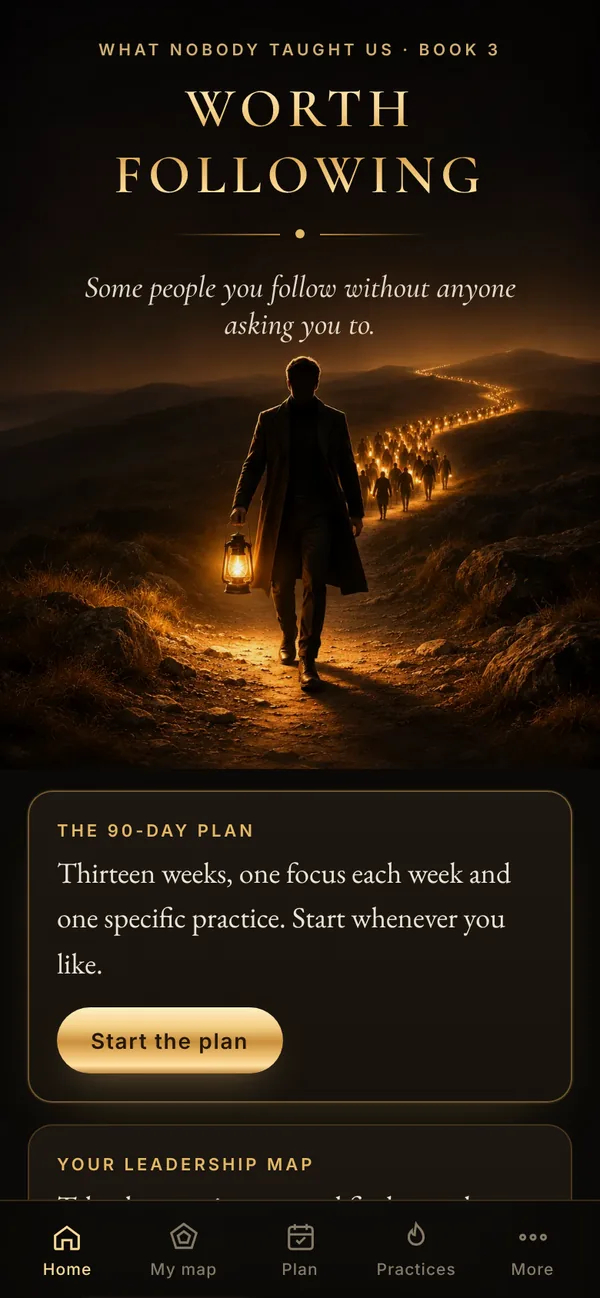
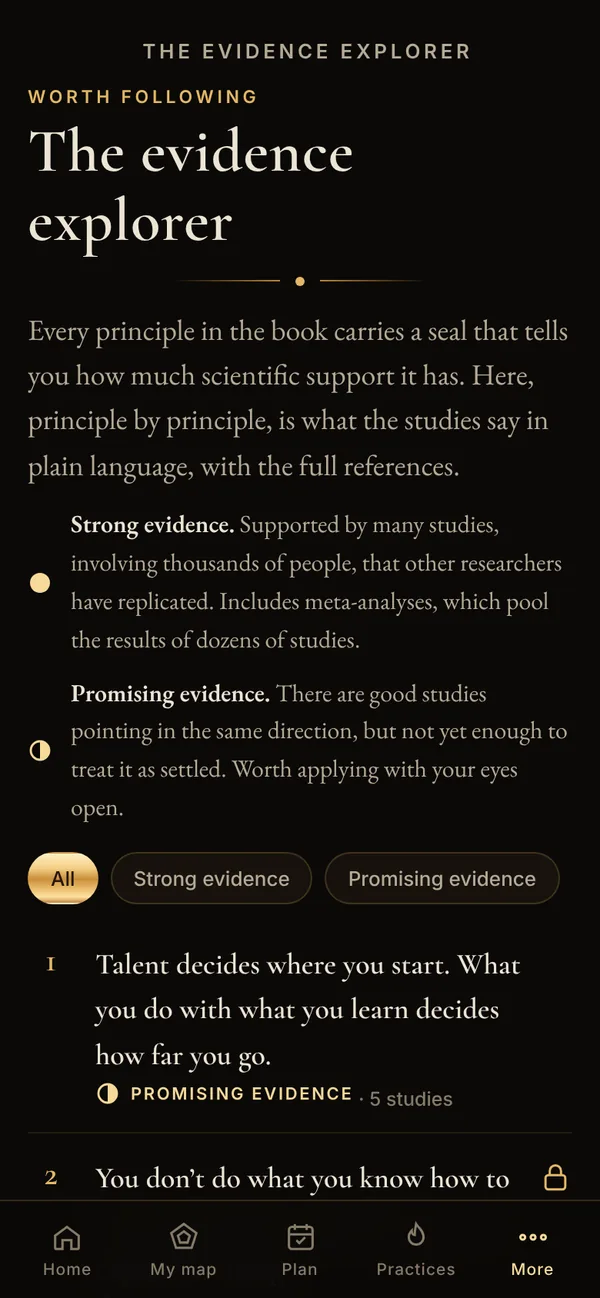
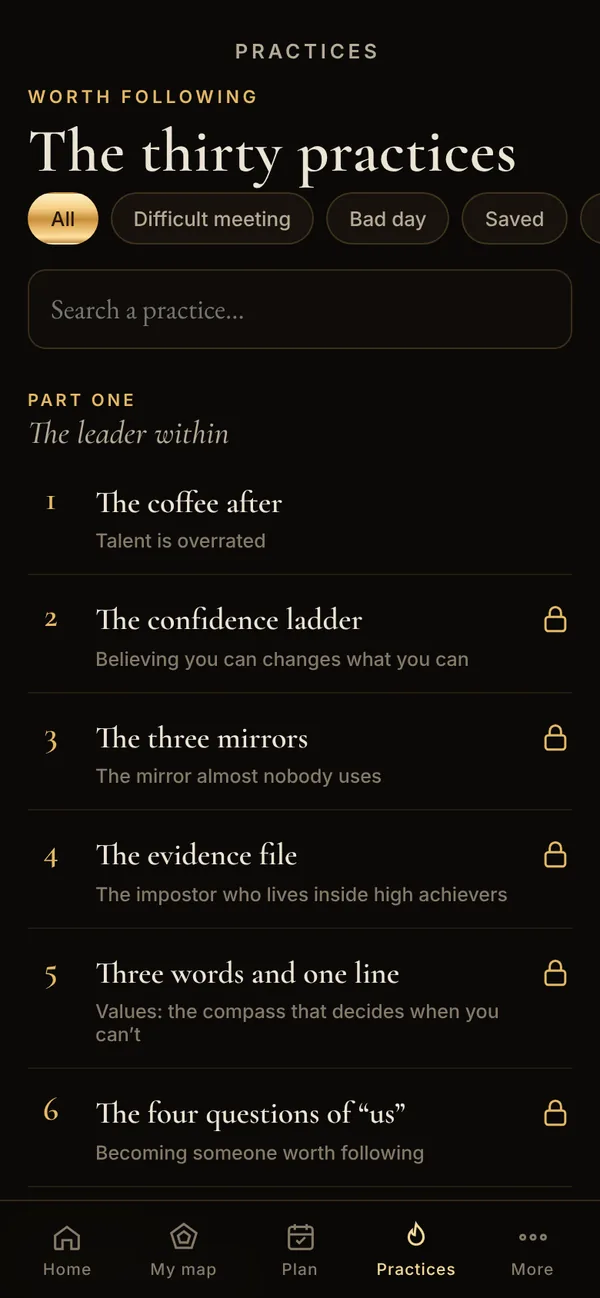
Free for every reader
Worth Following · The book’s app
What you have read, in your everyday life: your leadership map with the book’s self-assessment and how it evolves, the 90-day plan with a weekly reminder, the thirty practices, the evidence explorer and the ten myths game.
- 25statements in your leadership map
- 13weeks in the 90-day plan
- 30practices, one per principle
- Your leadership map
- The 90-day plan
- The 30 practices
- Before a difficult meeting
- After a bad day
- The evidence explorer
- The ten myths game
- Works offline
Free for readers. No account and no personal data: everything stays on your phone.
Install it on your phone
Like any other app, no app store needed
- iPhone: open the app in Safari, tap Share, then Add to Home Screen.
- Android: open it in Chrome, tap the ⋮ menu, then Install app.
- It appears with its own icon and works even without a connection. The first week is open to everyone; for the rest, you need the reader keyword printed at the end of the book.
A secret for those who reach the end
Six letters, one word
At the end of each of the five parts, and of the ten myths, there is a discreet letter printed on a small seal. If you write them down as you go, by the end you’ll have a six-letter word. That word opens a section of the app reserved for those who walk the whole path.
A clue: it’s what everyone worth following ends up leaving behind, whether they mean to or not.
Your success isn’t measured by what you achieve. It’s measured by what grows in others because of you.
Worth Following
Sergio’s voice
Hear it from the author
Why he wrote this book, and how it begins, read by him. You can follow the text as you listen.
Read by the author
Why I wrote “Worth Following”
Transcripción
Hi, I’m Sergio Pérez Serer.
There’s a question I’ve asked many times in my consulting room, to executives, to doctors, to teachers, to parents. Who tells you the truth?
There’s almost always a silence. Because there are people with talent, with results, with a title, whom nobody truly follows. And there are others, sometimes with no title at all, whom everyone seeks out when things go wrong.
I wrote Worth Following to show what those people do. It isn’t charisma or luck: it’s concrete things that can be learned. Thirty principles, each with its own scientific evidence rating, real cases from my practice, and something to try this very week.
It’s the third book in the What Nobody Taught Us trilogy. And if you like, I’ll read you how it begins.
Voz de Sergio Pérez Serer generada con IA a partir de su propia voz. Textos escritos por él.
Read the beginning
The first pages
Worth Following
Prologue · The Man Who Had Everything Except His Team
Raymond set the folder on the table the way you might lay evidence before a judge. It was blue, made of cardboard, the kind almost nobody uses anymore. Inside were four letters.
“Read them,” he said. “Actually, don’t bother. They all say the same thing.”
They were four resignation letters. Four of the six people who reported directly to him had left the company in eighteen months. A finance director with fifteen years in the firm. A plant manager he had trained himself. Two young sales leads, the brilliant kind it takes a decade to find. None of the letters contained a word of complaint. All of them thanked him. And all of them, one way or another, said they needed “a new challenge.”
Raymond was fifty-two and ran the manufacturing business his grandfather had founded. Under his leadership, revenue had doubled. He had opened markets in three countries. He arrived at seven thirty, knew every number, every client, every machine. His father, who still came by the factory on Fridays, liked to say he was the best of his three sons.
“I’ve done everything right,” he told me. “Everything. So why are they leaving?”
That was not why he had come, of course. Almost nobody comes to therapy for the real reason. Raymond had come because he was sleeping four hours a night, because his blood pressure had shot up, and because his wife, after a dinner during which he had not spoken to a soul, had told him that either he got help or she would be leaving too. The blue folder appeared in our third session. The question, in the fourth.
I asked him just one question in return.
“Raymond, in your company, who tells you the truth?”
He went quiet. I watched him search for a name. He opened his mouth, then closed it. He looked out of the window, down at the street, as if the answer might be somewhere in the traffic below.
“Nobody, I suppose,” he said at last. “Not anymore.”
I have thought about that silence many times. In more than twenty-five years of clinical practice I have heard it in a thousand different forms. The hospital director whose staff obey her but tell her nothing. The entrepreneur who built a company from scratch and now dreads walking into it. The middle manager who shouts in meetings and cries in his car. The brilliant professional who is never promoted and cannot understand why.
People with talent, with results, with drive. People who, like Raymond, have done “everything right.” And who nevertheless find themselves alone at the top, or stuck halfway up the ladder, with no idea what is missing.
And then there are the others.
You almost certainly know someone like that. The person everyone looks for when something goes wrong. Not always the one in charge. Sometimes they have no title at all. But when they speak, the room listens. When they propose something, people join in. When they get it wrong, people forgive them, because they know they will own it. And when they leave, they leave a gap nobody quite knows how to fill.
“Not the person with the most power. The person most worth following.”
For years I have watched these people with an almost obsessive curiosity: in my consulting room, in companies, in medical teams, in families. And for years I have read everything science has published about them. What I found surprised me. They were not extraordinary people. They did specific things, things that can be named, measured and learned. And almost none of those things appear in management handbooks.
Raymond learned them. It was neither quick nor easy, because first he had to unlearn some of the very things that had brought him so far. He learned to ask before deciding. He learned to stay silent in meetings long enough for others to speak. He learned to say “I was wrong” in front of his team, which cost him more than any negotiation of his life.
Eight months after the blue folder, late one Tuesday evening, I received a message from him. It said only this:
“Today, at the board meeting, someone disagreed with me in front of everyone. They were right. I thanked them. I think it’s the first time in ten years.”
This book is about what Raymond learned. And about what science has spent decades discovering about the people others follow.
If you have ever wondered why what comes naturally to others costs you so much, or if you have already gone far and discovered that it is cold at the top, these pages are for you.
Keep reading in the book.
On Amazon November 24, 2026
We’ll let you know the day it’s out
One email, on publication day, with the link to get it. That’s all.
Details
The book
- Title
- Worth Following
- Subtitle
- The Science of the People Others Choose to Follow
- Author
- Sergio Pérez Serer
- Series
- What Nobody Taught Us Trilogy · Book 3
- Pages
- 268 (paperback) · 276 (hardcover)
- Trim size
- 6 × 9 in
- Editions
- Paperback, hardcover, and Kindle
- Publication date
- November 24, 2026
- Language
- English · Edición en español: Referente
- Includes
- Opening self-assessment, 90-day plan, workbook, and free app
Three books that go hand in hand
The What Nobody Taught Us trilogy
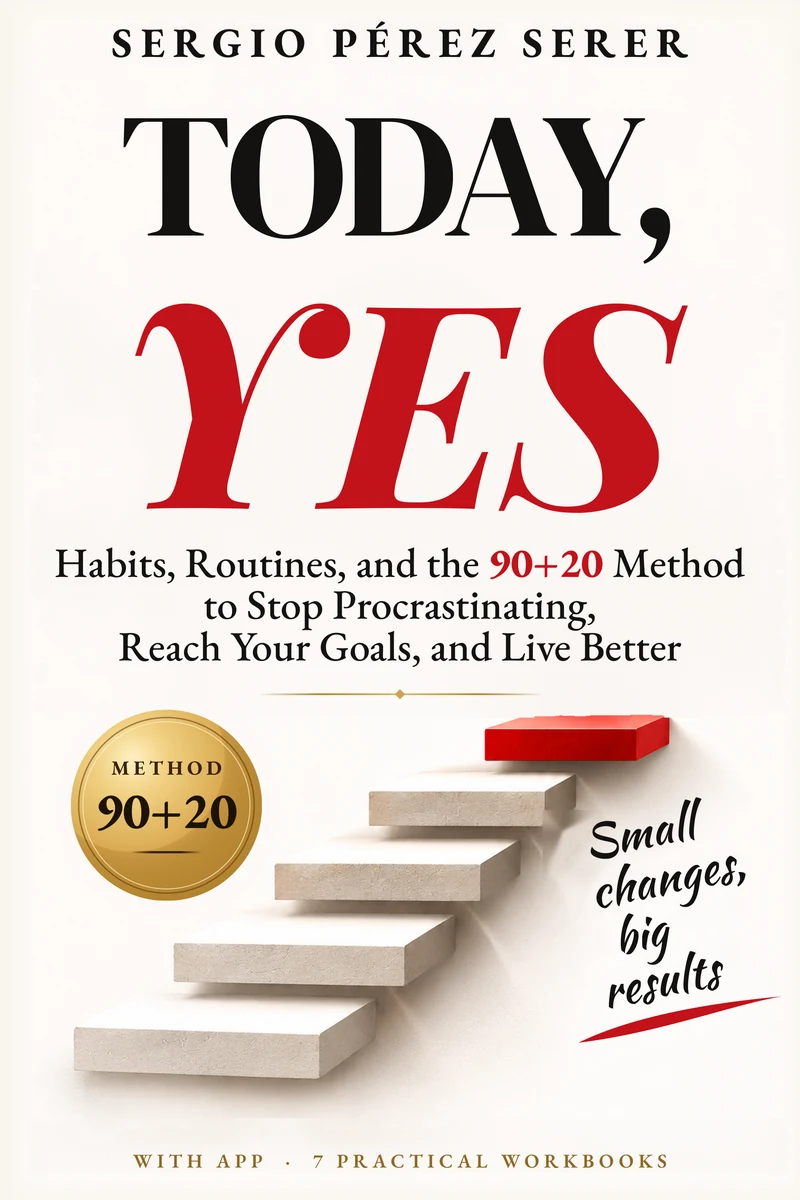
Magnetic is about connecting with others. Today, Yes is about turning what you want into what you do. Worth Following is about becoming someone others choose to follow. Each one stands on its own.

Before you read it
Frequently asked questions
Is it only for people who manage a team?
No. The book is about the people others choose to follow, and they are often not the ones in charge: sometimes they have no title at all. It is for executives and managers, and just as much for professionals, teachers, healthcare workers, entrepreneurs and parents.
Do I need to have read Magnetic and Today, Yes?
No. It is the third book in the What Nobody Taught Us trilogy, but it stands on its own. When a topic is covered in depth in one of the other two, the book points you to it in case you want to go further.
What do the evidence ratings mean?
Every principle carries a seal that tells you how much scientific support it has: strong evidence, promising evidence or myth. When something comes from the author’s clinical experience rather than from a study, it gets its own section.
What is the app, and how much does it cost?
It is free for readers and works on any phone, tablet or computer, with no account: your answers are stored only on your device. The first week is open to everyone; for the rest, you will need the reader keyword printed at the end of the book.
Which formats is it available in?
Paperback, hardcover and Kindle, on Amazon. And in Spanish, under the title Referente.

The author
Sergio Pérez Serer
Sergio Pérez Serer directs Clínica Pérez-Vieco in Valencia, Spain, where for more than twenty-five years he has guided individuals and teams through growth and change.
For years he has watched, in his consulting room, in companies, in medical teams, and in families, the people others choose to follow, and read everything science has published about them. Worth Following is the result. He is also the author of Magnetic and Today, Yes.
Worth Following
A book doesn’t change anyone. What changes you is what you do the Monday after reading it.
On Amazon November 24, 2026
Lines from the book
Lines worth sharing
If a line speaks to you, pass it on to someone who needs it today. Choose where to share it or download it as an image.
Prologue
“Not the person with the most power. The person most worth following.”
Introduction
“Nobody is born worth following. You become it, one decision at a time.”
Chapter 6
“A boss is appointed. Someone worth following is earned.”
Chapter 13
“Fear gets you obedience. Admiration gets you people.”
Chapter 15
“Trust can’t be requested. It accumulates, one promise at a time.”
Chapter 23
“If nobody on your team ever disagrees with you, you don’t have a team. You have an echo.”
Chapter 8
“Pressure doesn’t reveal who you are. It reveals what you’ve trained.”
Chapter 20
“You don’t motivate people. You stop demotivating them, and they do the rest.”
Chapter 4
“The impostor doesn’t live in your résumé. It lives in the way you read it.”
Chapter 12
“No success is worth its price if the price is you.”
Chapter 25
“A goal without a plan is just a wish with an expiry date.”
Chapter 30
“In the end, no one will ask what you achieved. They’ll ask whom you helped to get there.”