Reference work · Two volumes
Textbook of Clinical Sexology, Sex Therapy, and Couples Therapy
A Biopsychosocial and Relational Guide for Clinical Practice
Behind every symptom there is a body, a mind, a relationship, and a culture.
Coming soon to Amazon: hardcover, paperback, and Kindle
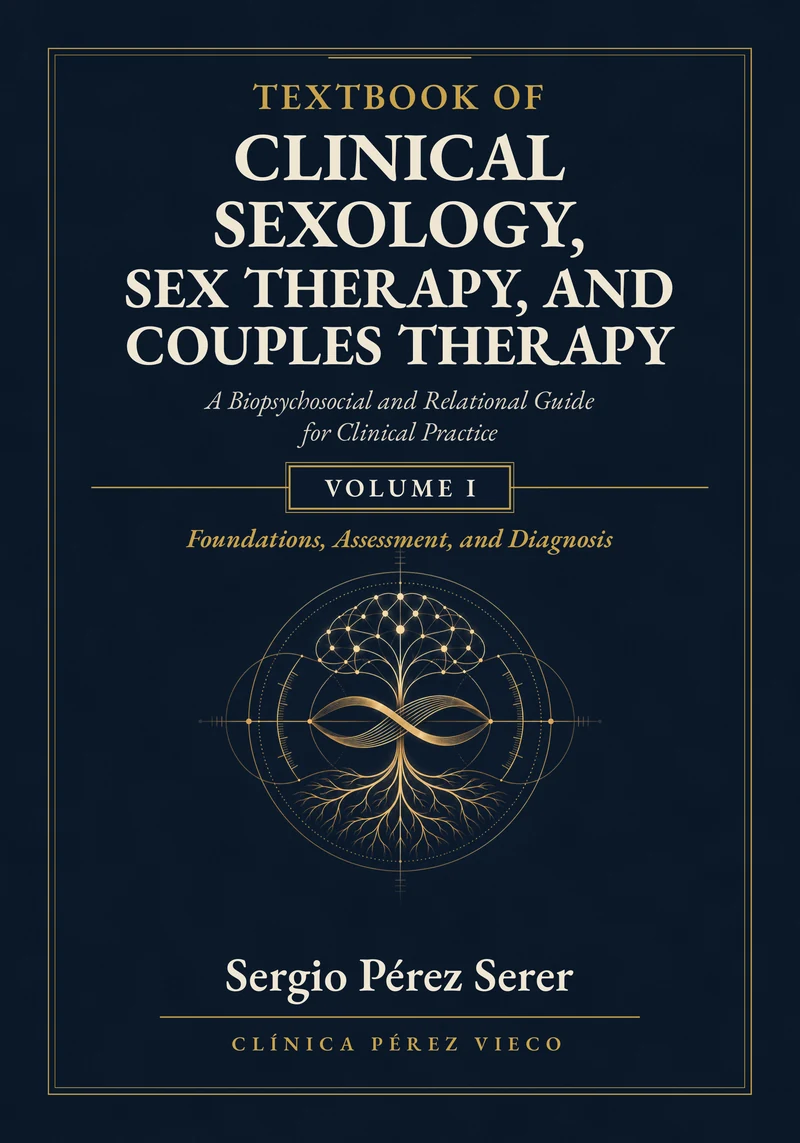
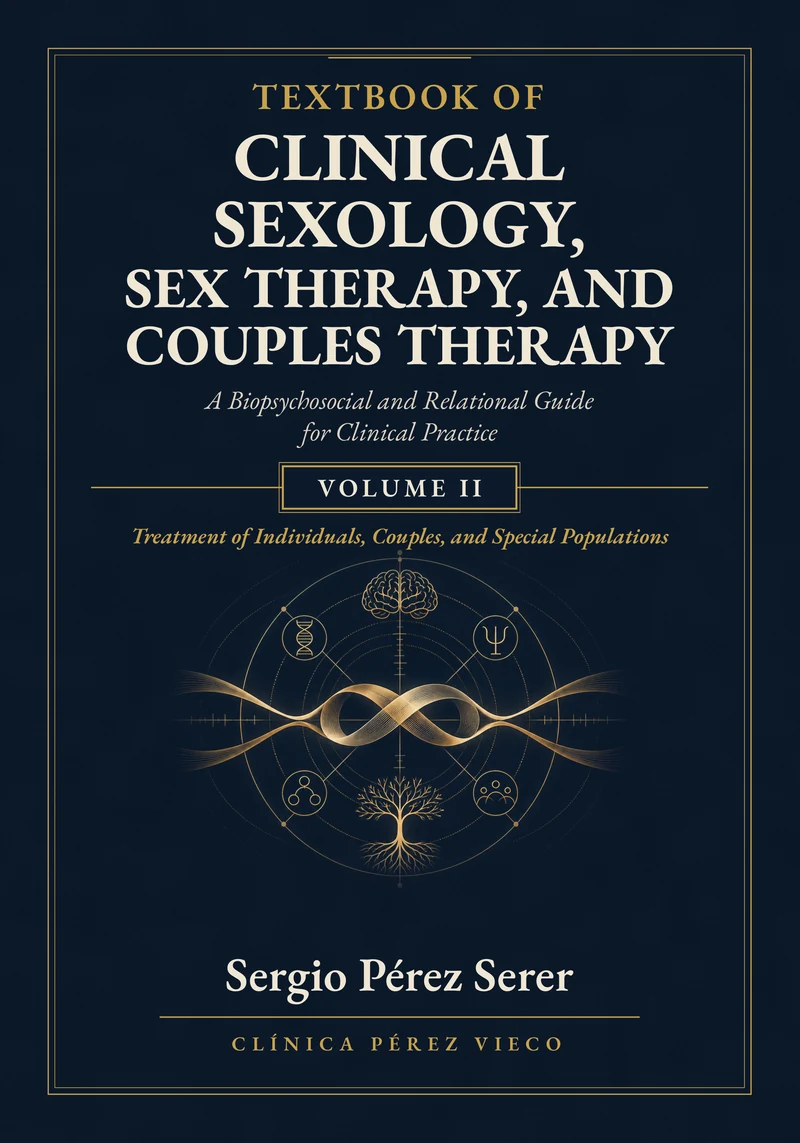
- 77chapters in eight parts
- 1,008pages in two volumes
- 12diagnostic algorithms
- 11clinical appendices: worksheets, protocols, and cases
A work for clinicians who ask themselves
“How do I assess, diagnose, and treat a sexual or relationship problem without seeing only one part of it?”
The work
Clinical sexology, from start to finish
The Textbook of Clinical Sexology, Sex Therapy, and Couples Therapy brings together, in two volumes, what clinicians need to treat sexual and relationship problems rigorously: from the biological, psychological, relational, and cultural foundations to assessment, diagnosis, and treatment.
Volume I covers the foundations, the full assessment of the individual and the couple, the DSM‑5‑TR and ICD‑11 classifications, and the main clinical problems. Volume II develops the interventions: step-by-step sex therapy, the schools and models of couples therapy, work with specific populations and contexts, and professional practice.
Sergio Pérez Serer wrote it from more than twenty-five years of clinical practice and teaching, with the latest international evidence cited in APA style, for psychologists, physicians, sexologists, couples therapists, and graduate students in any country.
Inside
- 01
A biopsychosocial and medical assessment protocol for every clinical problem.
- 02
Twelve diagnostic algorithms and the red flags that call for referral.
- 03
The two major classifications, DSM‑5‑TR and ICD‑11, compared problem by problem.
- 04
Integrative sex therapy, with session-by-session protocols and 39 homework worksheets.
- 05
The best-supported models of couples therapy, integrated with sex therapy.
- 06
Clinical cases, key points, and review questions in every chapter, designed for teaching.
“Only a perspective integrating all of these dimensions allows us to understand the person who consults and to truly help them.”
Two volumes, one work
Choose your volume and format
Each volume stands on its own, and the two cross-reference each other chapter by chapter. Gloss-finish hardcover, paperback, and Kindle.
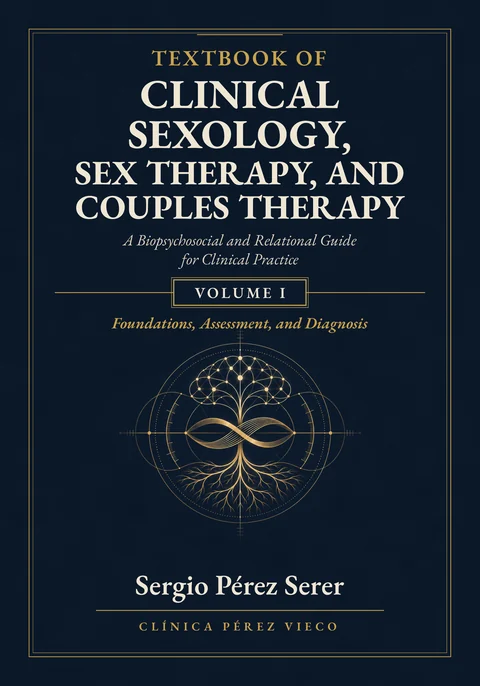
Volume I
Foundations, Assessment, and Diagnosis
History, culture, and anthropology of sexuality; anatomy, physiology, neurobiology, and attachment; the full assessment of the individual and the couple; DSM‑5‑TR and ICD‑11 diagnosis, and the main clinical problems.
Chapters 1–40 · Parts 1–4 · 527 pages · Appendices A–F and glossary
Coming soon to Amazon: hardcover, paperback, and Kindle
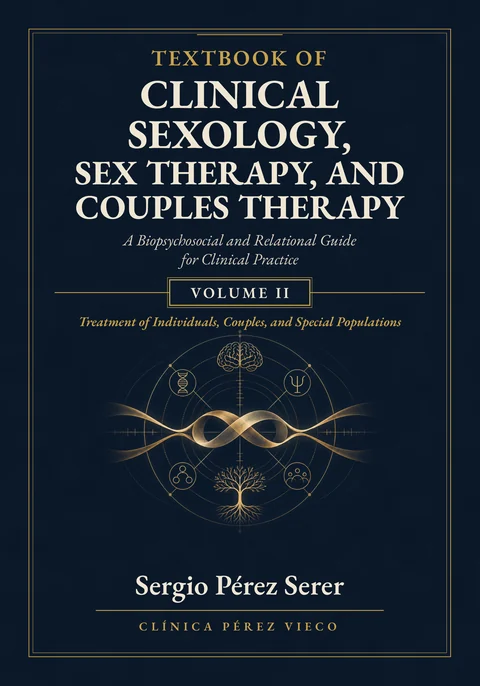
Volume II
Treatment of Individuals, Couples, and Special Populations
Step-by-step sex therapy; the schools and models of couples therapy; the life cycle, illness, culture, and diversity, and professional practice.
Chapters 41–77 · Parts 5–8 · 481 pages · Appendices G–K and glossary
Coming soon to Amazon: hardcover, paperback, and Kindle
Also available in Spanish: Tratado de sexología clínica, terapia sexual y terapia de pareja
Why this textbook
Made to be used, not just read
Clinical cases in every chapter
Real-world consultations with their formulation and questions to think through.
Diagnostic algorithms
From presenting complaint to differential diagnosis and referral criteria.
DSM‑5‑TR and ICD‑11
Both classifications, compared problem by problem.
Up-to-date evidence
Recent international research, cited in APA style.
Worksheets, protocols, and cases
Eleven clinical appendices ready for practice and teaching.
Bilingual glossary
Every term with its Spanish equivalent, for working across languages.
- low sexual desire in men
- low sexual interest or arousal in women
- desire discrepancy
- erectile dysfunction
- rapid ejaculation
- ejaculatory disorders
- female orgasmic difficulties
- genito-pelvic pain
- male sexual pain
- “out-of-control” sexual behavior
- paraphilic interests
- uncommon conditions
Contents
Seventy-seven chapters in eight parts
Part 1 · Volume IFoundations
- 1Clinical Sexology
- 2Sexual Anthropology
- 3Sexual Customs and Culture Around the World
- 4Epidemiology of Sexual Problems
- 5Functional Anatomy
- 6Physiology of Sexual Response
- 7Neuroendocrinology of Sexuality
- 8Neurobiology of Desire, Arousal, and Pleasure
- 9Models of Sexual Response
- 10Attachment, Bonding, and Desire
- 11Sexual Development Across the Lifespan
- 12Sexual, Gender, and Relationship Diversity
Part 2 · Volume IAssessment
- 13The Assessment Framework
- 14The Comprehensive Sexual History
- 15Medical and Medication History
- 16Contraception, Fertility, Assisted Reproduction, and Sexual Function
- 17Sexually Transmitted Infections and Prevention
- 18Physical Examination
- 19Laboratory Tests
- 20Specialized Tests
- 21Assessment Instruments
- 22Assessing the Couple
Part 3 · Volume IDiagnosis
- 23Classification Systems
- 24Case Formulation
- 25General Differential Diagnosis
- 26Psychiatric Comorbidity
- 27Substances, Chemsex, and Sexuality
- 28Differential Diagnosis Case Problems
Part 4 · Volume ISexual Dysfunctions and Clinical Problems
- 29Hypoactive Sexual Desire in Men
- 30Female Sexual Interest/Arousal Disorder
- 31Desire Discrepancy
- 32Erectile Dysfunction
- 33Premature Ejaculation
- 34Delayed Ejaculation and Other Ejaculatory Disorders
- 35Female Orgasmic Disorder
- 36Genito-Pelvic Pain/Penetration Disorder
- 37Male Sexual Pain and Peyronie’s Disease
- 38Compulsive Sexual Behavior Disorder
- 39Paraphilias and Paraphilic Disorders
- 40Other Clinical Conditions
Part 5 · Volume IISex Therapy: Step-by-Step Techniques
- 41Principles of Sex Therapy
- 42Sensate Focus
- 43Ejaculation Techniques
- 44Self-Exploration and Directed Masturbation
- 45Pain and Penetration
- 46Sexual Mindfulness and Acceptance
- 47Cognitive and Emotional Interventions
- 48Medical Treatments in the Sexologist’s Practice
- 49Treatment Modalities: Group, Online, Systemic, and Narrative
- 50Week-by-Week Treatment Protocols
Part 6 · Volume IICouples Therapy
- 51Evidence-Based Models of Couple Therapy
- 52Assessment, Formulation, and Structure of Conjoint Therapy
- 53Communication, Conflict, and Repair
- 54Infidelity
- 55Jealousy, Control, and Intimate Partner Violence
- 56Integrating Sex Therapy and Couple Therapy
- 57Infertility and Perinatal Loss
- 58Serious Illness and Addiction in the Couple
- 59Forgiveness and Reconciliation
- 60Breakup, Separation, and New Relationship Configurations
Part 7 · Volume IIPopulations and Contexts
- 61Pregnancy, Postpartum, and Parenting
- 62Menopause, Late-Onset Hypogonadism, and Aging
- 63Chronic Illness and Sexuality
- 64Cancer and Sexuality
- 65Physical and Intellectual Disability
- 66LGBTQIA+ People
- 67Childhood and Adolescence
- 68Trauma and Sexual Abuse
- 69Serious Mental Illness and Sexuality
- 70Cultural and Religious Competence
- 71Cultural Practices That Violate Rights
- 72Digital Sexuality
Part 8 · Volume IIProfessional Practice
- 73Ethics and Comparative Legal Framework
- 74Training and Accreditation in Clinical Sexology
- 75Interdisciplinary Work and Referral
- 76Measuring Outcomes and Practice-Based Research
- 77Documentation, Online Practice, Supervision, and Self-Care
Appendices: sexological assessment form, assessment instruments, reference laboratory values, medications and sexual function, scientific societies and resources, formulation template, homework worksheets, session-by-session protocols, violence screening and safety plan, teaching cases, and essential library. A bilingual glossary in each volume.
Beyond the book
The textbook, in your practice
Free for readers
Textbook · Consult
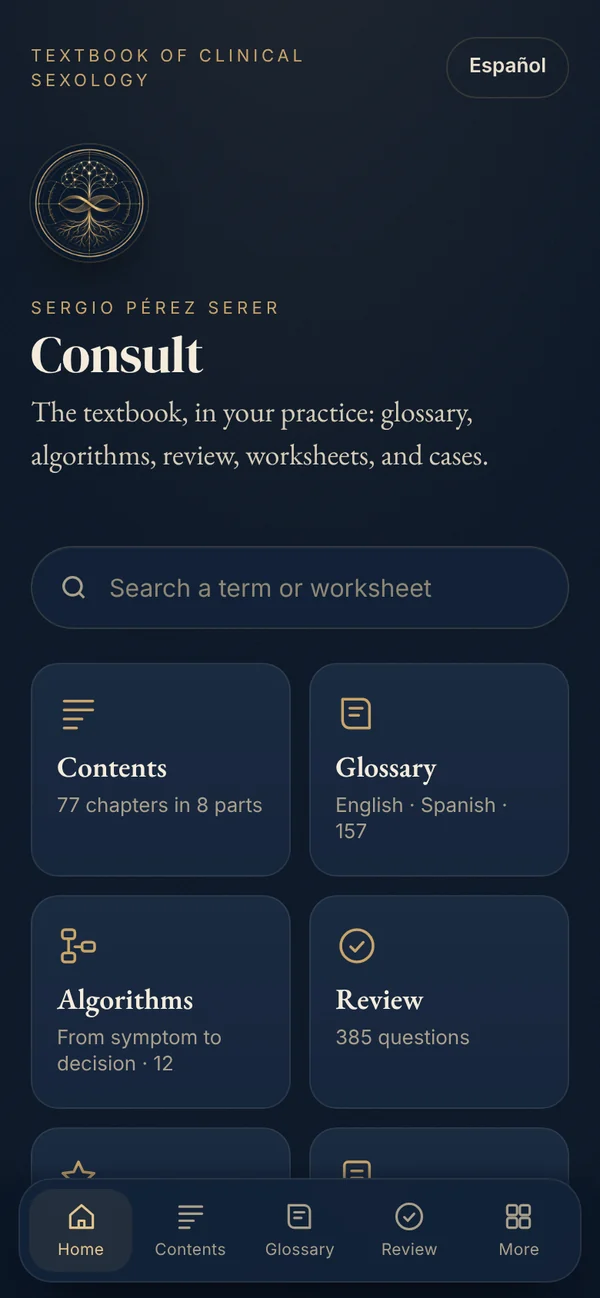
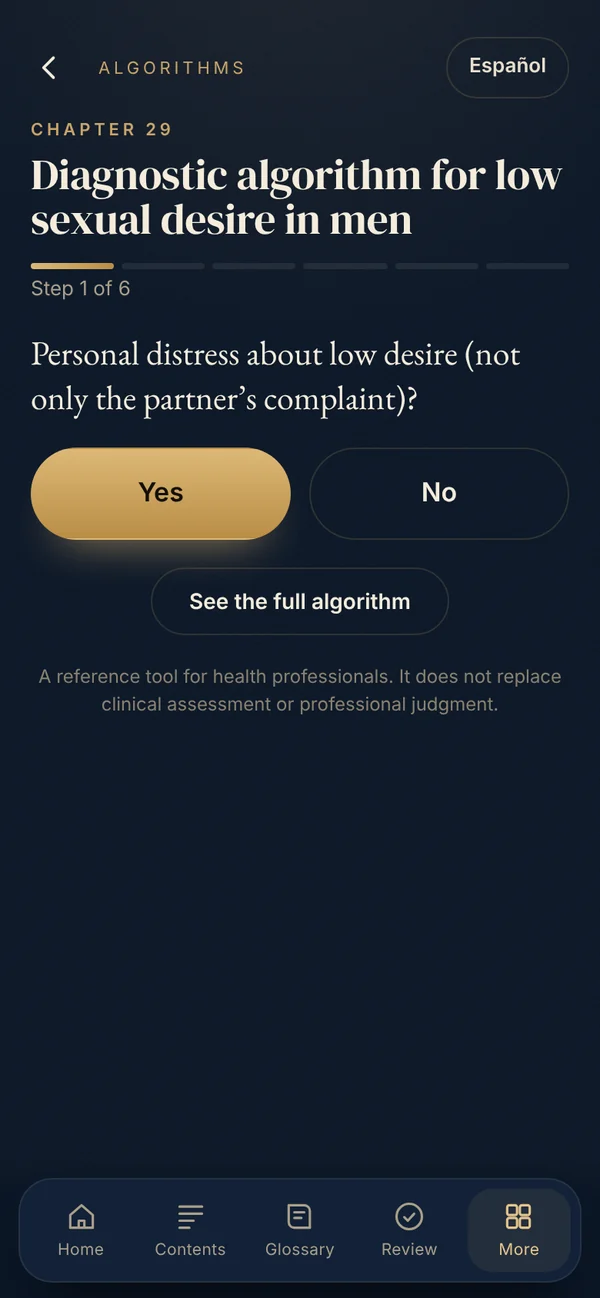
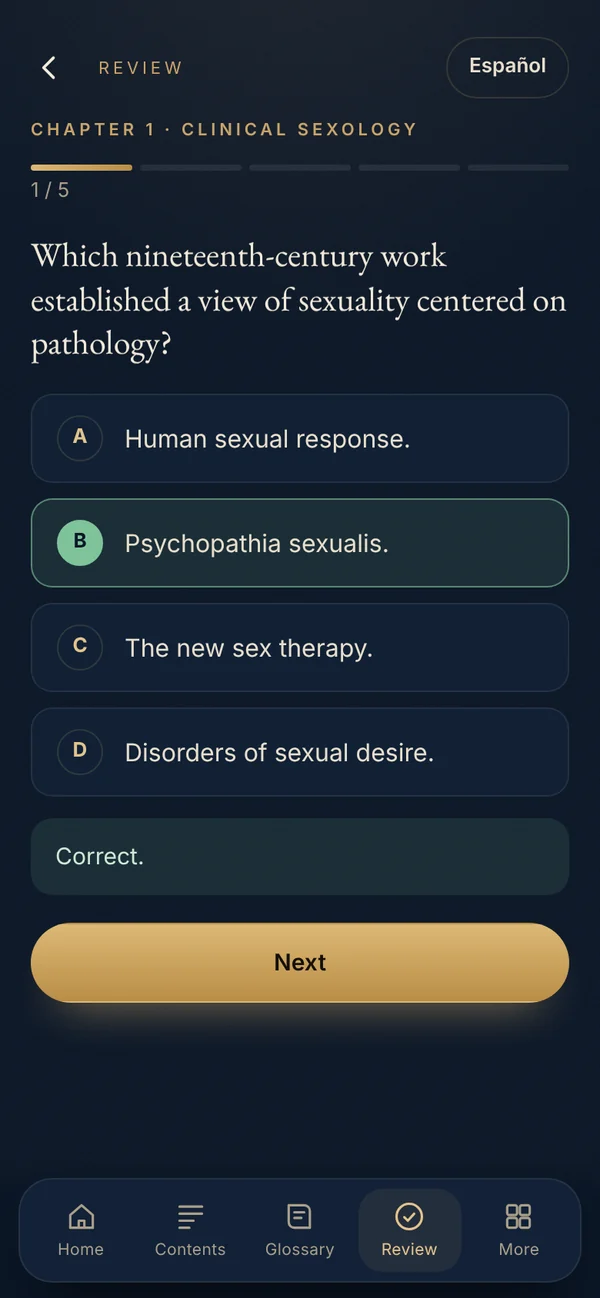
The reader app brings the textbook into your practice: the bilingual glossary, twelve step-by-step diagnostic algorithms, 385 review questions with an exam mode, the key points and referral criteria of all 77 chapters, worksheets to fill in and print, session-by-session protocols, and teaching cases. It installs on your phone and works offline.
- 12diagnostic algorithms
- 385review questions
- 39printable worksheets
- English–Spanish glossary
- Interactive algorithms
- Exam mode
- Key points and referral
- Fillable worksheets
- Session protocols
- Teaching cases
- Works offline
Free for readers of the textbook. The glossary and a sample of every section are open to everyone.
Install it on your phone
Like any other app, no app store needed
- iPhone: open the app in Safari, tap Share, then Add to Home Screen.
- Android: open it in Chrome, tap the ⋮ menu, then Install app.
- It appears with its own icon and works even offline. Whatever you write in the worksheets and cases is saved only on your device.
The reader area
A keyword in your volume
The full glossary and a sample of every section are open to everyone. For the rest, each volume has a keyword and a QR code printed on the app page: scan it and the reader area unlocks by itself, on your phone and on your computer.
For health professionals
Only a perspective integrating all of these dimensions allows us to understand the person who consults and to truly help them.
Textbook of Clinical Sexology
Before you begin
Preface
Textbook of Clinical Sexology · Volume I
Preface
People who come to a sexology clinic rarely bring a simple problem. Behind an erection that fails, a desire that fades, or a pain that will not go away there is almost always a body with its medical history, a mind with its fears and learning, a relationship with its balances, and a cultural context that gives meaning to what is happening. This textbook grew out of the conviction that only a perspective integrating all of these dimensions allows us to understand the person who consults and to truly help them.
The book is written for psychologists, physicians, sexologists, couple therapists, nurses and physical therapists, and graduate students who treat, or are preparing to treat, sexual and relationship problems. It is designed to be useful in any country: it draws on the international consensus statements of scientific societies and the World Health Organization, compares the two major diagnostic classifications—DSM‑5‑TR and ICD‑11—and points out where regulations, approved medications, and resources differ between the United States, Europe, Spain, and Latin America.
The textbook is organized in two volumes. This first volume brings together the foundations of clinical sexology—history, culture, epidemiology, anatomy, physiology, neurobiology, models of sexual response, attachment, the life cycle, and diversity—the full assessment—interview, medical and medication history, physical examination, tests, instruments, and couple assessment—and diagnosis—classifications, case formulation, differential diagnosis, and comorbidity. It closes with the main clinical problems, each with its assessment, differential diagnosis, and treatment outline. The second volume covers the interventions in depth: sex therapy, couples therapy, and work with specific populations and situations.
Special care has been given to assessment. Accurate diagnosis is the basis of any effective treatment, and in sexology errors often come from looking at only one part of the problem: attributing to anxiety what is vascular disease, treating as an individual dysfunction what is a couple cycle, or overlooking a medication, depression, or a situation of violence. For this reason each clinical chapter includes a biopsychosocial and medical assessment protocol, the red flags that call for referral, a diagnostic algorithm, and an example case formulation.
Every relevant statement is supported by verified studies, guidelines, and consensus documents, cited in APA style. Even so, sexology moves quickly, and no book replaces clinical judgment or ongoing professional development. I hope these pages accompany readers in their practice and, above all, help the people who entrust them with their intimacy.
Sergio Pérez Serer
Coming soon to Amazon: hardcover, paperback, and Kindle
We’ll let you know the day it’s out
One email, on publication day, with the links to both volumes. That’s all.
Details
The work
- Title
- Textbook of Clinical Sexology, Sex Therapy, and Couples Therapy
- Subtitle
- A Biopsychosocial and Relational Guide for Clinical Practice
- Author
- Sergio Pérez Serer
- Volumes
- I · Foundations, Assessment, and Diagnosis · II · Treatment of Individuals, Couples, and Special Populations
- Pages
- Volume I: 527 · Volume II: 481
- Trim size
- 7 × 10 in · cream paper
- Editions
- Hardcover, paperback, and Kindle
- Language
- English · Spanish edition
- Includes
- Eleven clinical appendices, a bilingual glossary, and a reader app
Before you choose
Frequently asked questions
Can I buy just one volume?
Yes. Each volume stands on its own: the first covers foundations, assessment, and diagnosis; the second, the interventions. Together they form a single work, with exact cross-references between volumes.
Is it suitable as a graduate textbook?
It was designed for that. Every chapter includes learning objectives, key points, review questions with answers, and teaching cases, and the second volume adds session-by-session protocols and homework worksheets.
Which countries is it for?
Any. It draws on international and WHO consensus statements, compares DSM‑5‑TR with ICD‑11, and points out where regulations, approved medications, and resources differ between the United States, Europe, Spain, and Latin America.
Is there a Spanish edition?
Yes: «Tratado de sexología clínica, terapia sexual y terapia de pareja», in the same two volumes, in hardcover, paperback, and Kindle.
What does the reader app include?
The bilingual glossary, twelve diagnostic algorithms, 385 review questions with an exam mode, the key points and referral criteria of every chapter, fillable and printable worksheets, protocols, and cases. It installs on your phone and works offline. The keyword to unlock it is printed in the book.
What formats is it published in?
Hardcover, paperback, and Kindle. The print edition measures 7 × 10 in, on cream paper.

The author
Sergio Pérez Serer
Sergio Pérez Serer is a psychologist and sexologist with more than twenty-five years of clinical practice at Clínica Pérez-Vieco in Valencia, Spain, where he treats individuals and couples in person and online in four languages.
He combines his clinical work with teaching in master’s programs in sexology and couples therapy, supervising master’s theses, and training clinicians. This textbook gathers what that practice and the latest research have taught him.
The reference work, in your practice
No book replaces clinical judgment. This one aims to accompany it.
Coming soon to Amazon: hardcover, paperback, and Kindle